
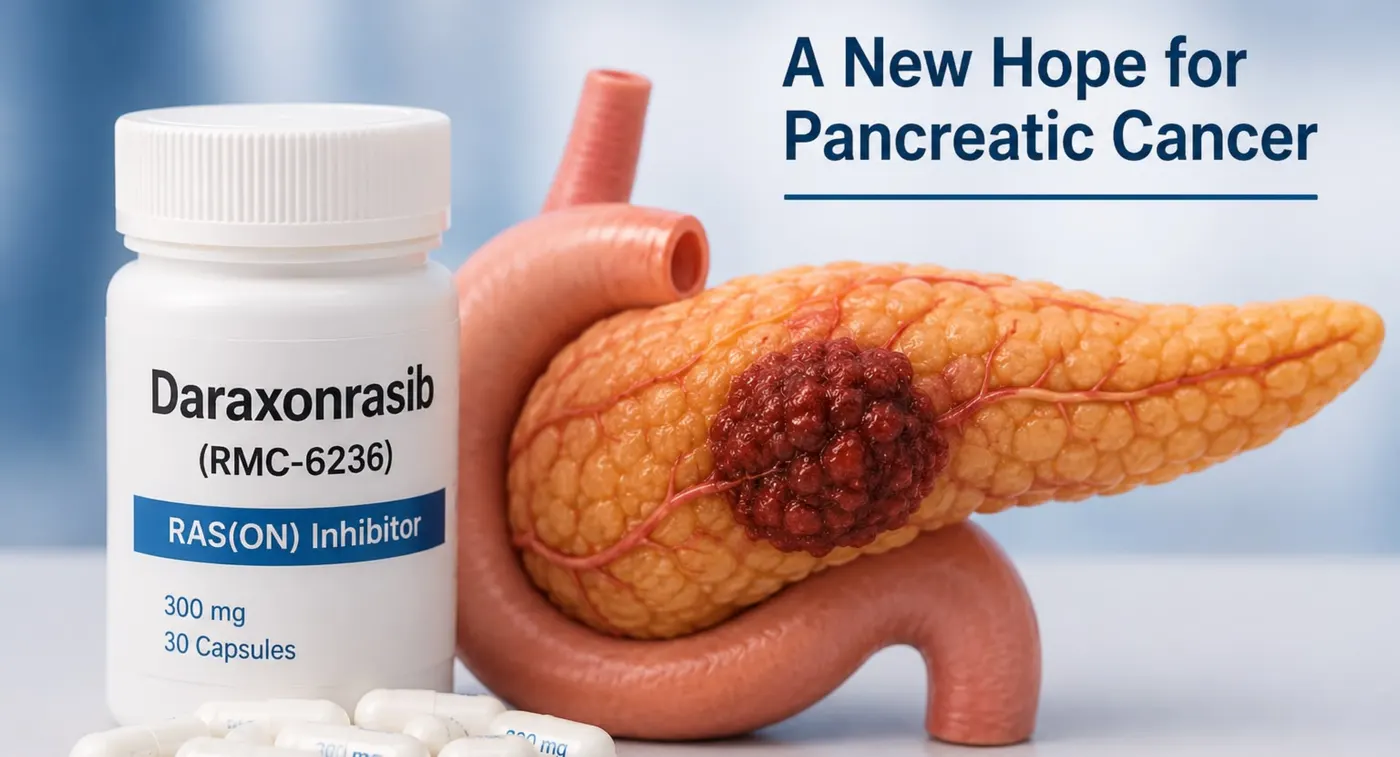
LONDON — Oncologists are hailing a daily targeted pill as the biggest breakthrough in pancreatic cancer treatment in decades after early clinical trials showed the drug stopped tumour growth in over 90% of patients and caused cancer to completely disappear on scans in some cases.
The medication, daraxonrasib, is designed to attack one of the deadliest and most notoriously difficult-to-treat forms of cancer. In an early-phase international trial involving 61 patients recently diagnosed with advanced, metastatic pancreatic cancer, researchers combined the daily pill with standard chemotherapy.
The results stunned specialists: tumours stopped growing in 90.2% of participants, and in one in 12 patients (roughly 8%), tumours shrank until they became completely undetectable on CT scans.

"Drugging the Undruggable"
Pancreatic cancer has the lowest survival rate of all common cancers, largely because it rarely causes noticeable symptoms until it has already spread to other organs. Most patients diagnosed with advanced stages survive for months rather than years.
For decades, scientists struggled to target the primary genetic driver behind the disease. More than nine in 10 pancreatic tumours carry a mutation in a protein called KRAS (part of the RAS family), which acts like a stuck accelerator pedal—constantly sending signals telling cancer cells to multiply uncontrollably. Because of its smooth surface, scientists long nicknamed KRAS the "Death Star" protein, believing it was impossible to block with medication.
Daraxonrasib overcomes this barrier by binding to a helper protein inside cells, forming a complex that locks onto the mutated KRAS protein and switches off its growth signals.
Experts like Dr. Sam Godfrey of Cancer Research UK have hailed the treatment as a long-overdue breakthrough in "drugging the undruggable". Dr. Wungki Park of Memorial Sloan Kettering Cancer Center noted that observing complete tumour disappearance in metastatic cases is nearly unprecedented, calling it "the closest to cure".
Extending Survival and Broader Potential
The trial follows earlier data that led the U.S. Food and Drug Administration (FDA) to approve daraxonrasib for previously treated patients after it nearly doubled median survival rates. Because RAS mutations drive roughly 20% of all human cancers, researchers believe the targeted therapy could eventually pave the way for treating lung, ovarian, and colorectal tumors.
A Call for Caution
Despite the landmark results, specialists emphasize that larger Phase 3 trials are necessary to verify long-term remission rates and determine how long the disease can be kept at bay before the pill can be widely adopted in healthcare systems like the UK's NHS.