
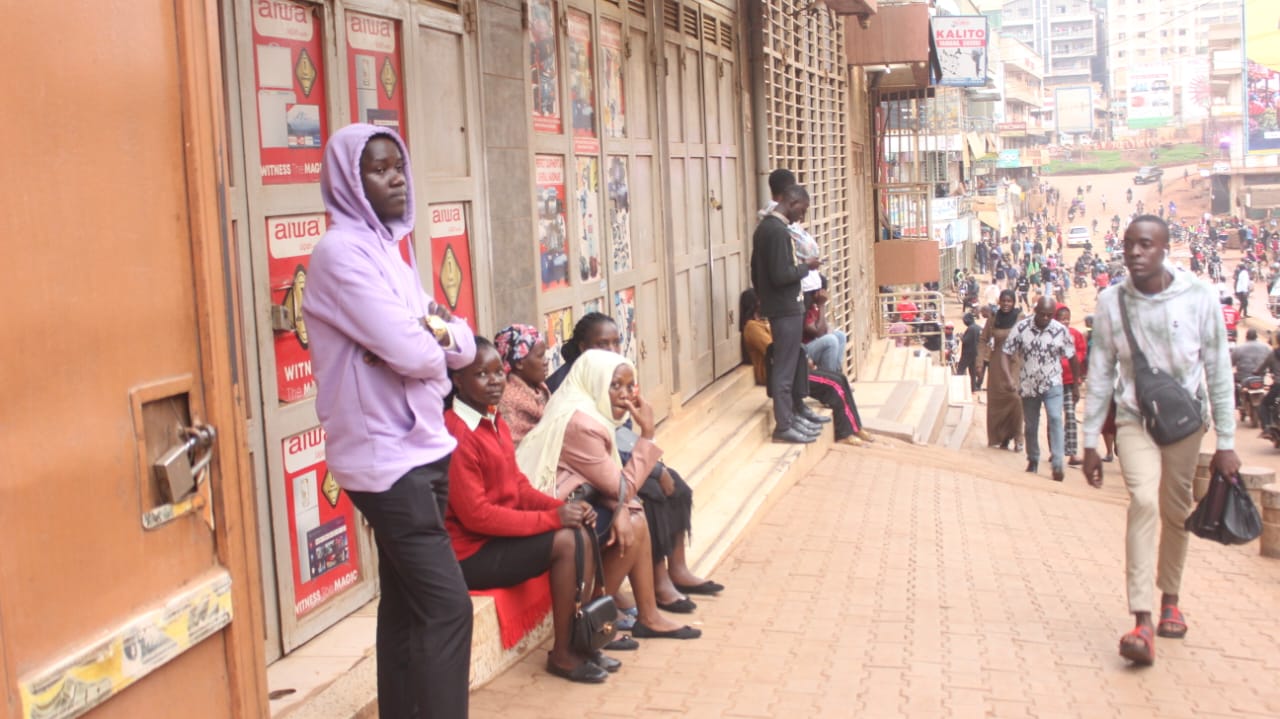
The shutdown affected several shopping arcades, commercial buildings and business centres across the city, leaving normally busy trading areas unusually quiet as traders stayed away from their shops to demonstrate their dissatisfaction with the current tax regime.
The protest comes amid growing concerns among sections of the business community over the cost of doing business, tax assessments, enforcement procedures and the financial pressure facing traders.
A spot check in different parts of Kampala revealed numerous closed business premises, with employees and shop attendants seen seated outside their workplaces, some scrolling through their phones as they waited for developments.
Unlike the usual bustling atmosphere characterised by shoppers, wholesalers, retailers and street vendors, several commercial streets recorded reduced activity, with little movement of customers and business operators.
Police officers were deployed in various parts of the city to monitor the situation and maintain law and order as the planned demonstration unfolded.
The closure of businesses has raised concerns about the financial implications for traders, employees and other people whose livelihoods depend on daily commercial activities.
Kampala Arcade Traders Chairperson Charles Yiga, however, appealed to traders to reconsider the shutdown, warning that continued closure of shops could undermine their businesses at a time when they should be maximising sales ahead of the Christmas festivities.
Yiga argued that demonstrations and business closures would not necessarily address the concerns raised against URA, urging traders to embrace dialogue with government and seek a lasting solution.
“I am requesting all traders to stop the demonstration because this doesn't help us. This is the season when we have to make money, so if we waste it, it will not be beneficial to us. Let's calm down, find a way of talking to the government and see how we can sort this out,” Yiga said.
He maintained that the business community should prioritise negotiations and engagement with government instead of sacrificing valuable trading days, particularly during a period when many businesses depend on increased consumer spending.

Meanwhile, Uganda Traders and Entrepreneurs Association (UTEA) Chairperson Edward Ntale shifted attention to government, arguing that concerns surrounding taxation should not be directed at URA alone but should also involve the authorities responsible for formulating tax policies.
Ntale said business leaders have a responsibility to present traders' grievances to the relevant government institutions and push for reforms that reflect the prevailing economic conditions.
He argued that some of the existing laws and regulations have increased the financial burden on businesses, insisting that government should reconsider policies that traders say are making it difficult to operate profitably.
“Our role as leaders is to take information to those who are in charge. We can't blame URA because they are also sent. It's the government; it has to reduce the number of laws it makes because Ugandans don't have money,” Ntale said.
The traders' concerns have once again brought Uganda's taxation system into focus, particularly the balance between government revenue collection, business survival and the need to encourage private sector growth.
The dispute also highlights the growing demand for engagement between government, URA and business associations to address complaints surrounding tax administration and enforcement.
As the festive season approaches, the shutdown presents an additional challenge for traders who traditionally rely on increased sales during November and December to recover investments, meet financial obligations and sustain their businesses.
The situation has also raised questions about the impact of prolonged business disruptions on workers, suppliers, landlords and other players within Kampala's commercial chain.
Traders are now looking to government for meaningful engagement and possible reforms, while business leaders continue to urge restraint, warning that prolonged closures could deepen the financial difficulties facing the very businesses seeking relief.